
In 2026, businesses are no longer just using artificial intelligence for simple automation tasks. Instead, they are adopting a more advanced form of intelligence known as agentic AI, which is transforming how enterprises operate, make decisions, and scale processes. Unlike traditional automation tools that follow fixed rules, agentic AI systems can think, plan, execute tasks, and adapt dynamically based on outcomes.
This shift is redefining enterprise automation across industries such as finance, healthcare, retail, logistics, and software development. Companies are now using agentic AI for business to reduce operational costs, improve decision-making speed, and create highly autonomous workflows that require minimal human intervention.
In this blog, we will explore how agentic AI is revolutionizing enterprise automation in 2026, its benefits, real-world applications, challenges, and future trends.
What Is Agentic AI?
Agentic AI refers to intelligent systems that act as autonomous “agents” capable of understanding goals, breaking them into tasks, executing actions, and learning from results. Unlike traditional AI models that only respond to prompts, agentic AI can operate independently across multiple systems.
Modern enterprise AI automation relies heavily on these agent-based systems to handle complex workflows such as customer support, data analysis, software operations, and business process management.
In simple terms, agentic AI doesn’t just assist—it acts.
Why Agentic AI Is Transforming Enterprise Automation in 2026
The rise of agentic AI for business is driven by the need for faster, smarter, and more scalable operations. Enterprises are dealing with massive data volumes, increasing customer expectations, and complex digital ecosystems. Traditional automation tools are no longer enough.
Agentic AI solves this by introducing intelligent autonomy into business processes. Instead of executing pre-programmed steps, it analyzes situations, chooses the best path, and executes tasks across multiple systems.
This evolution is the core reason enterprise AI automation is undergoing a major transformation in 2026.
Key Benefits of Agentic AI for Business
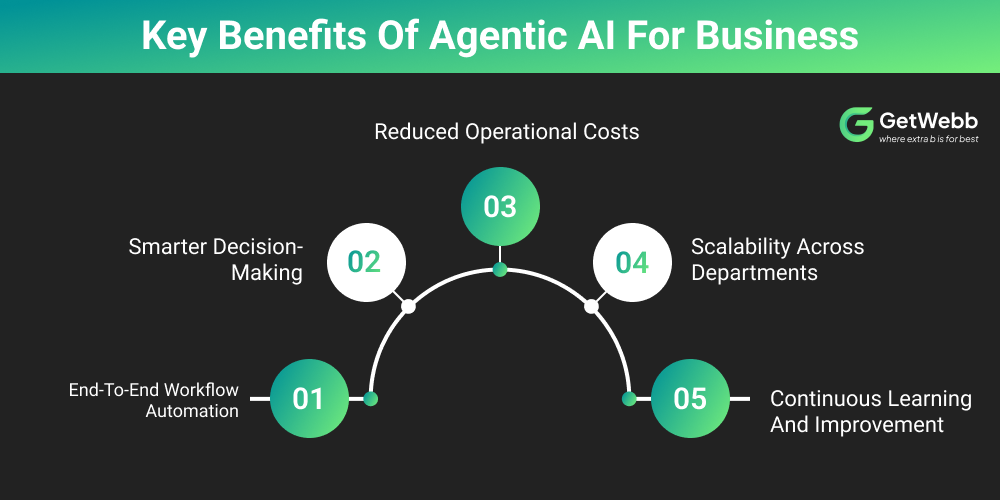
1. End-to-End Workflow Automation
One of the biggest advantages of agentic AI for business is its ability to manage entire workflows from start to finish. Instead of automating isolated tasks, it connects systems, tools, and decisions into a unified process.
Modern enterprise AI automation platforms use agents to handle onboarding, reporting, customer communication, and internal operations without manual intervention.
2. Smarter Decision-Making
Agentic AI systems can analyze real-time data and make decisions based on context. This makes enterprise AI automation more intelligent and adaptive compared to traditional rule-based systems.
Businesses using agentic AI for business can respond to market changes faster and more accurately.
3. Reduced Operational Costs
By minimizing manual work, companies significantly reduce staffing and operational costs. With enterprise AI automation, repetitive tasks like data entry, scheduling, and reporting are handled automatically.
Organizations that implement agentic AI for business often see substantial savings in time and resources.
4. Scalability Across Departments
Agentic AI systems can easily scale across departments such as HR, finance, marketing, and customer service. This makes enterprise AI automation highly flexible for growing businesses.
Whether a company processes 100 or 1 million tasks, agentic AI for business maintains efficiency.
5. Continuous Learning and Improvement
Unlike traditional automation tools, agentic AI learns from outcomes and improves over time. This makes enterprise AI automation more powerful as it evolves with business needs.
How Agentic AI Works in Enterprise Automation
Agentic AI operates through a combination of large language models, decision-making engines, memory systems, and tool integrations. These components work together to create autonomous workflows.
In agentic AI for business, an AI agent typically follows this cycle:
- Understand the goal
- Break it into sub-tasks
- Access tools and systems
- Execute actions
- Evaluate outcomes
- Improve future performance
This cycle enables advanced enterprise AI automation that goes far beyond traditional RPA (Robotic Process Automation).
Real-World Applications of Agentic AI in 2026
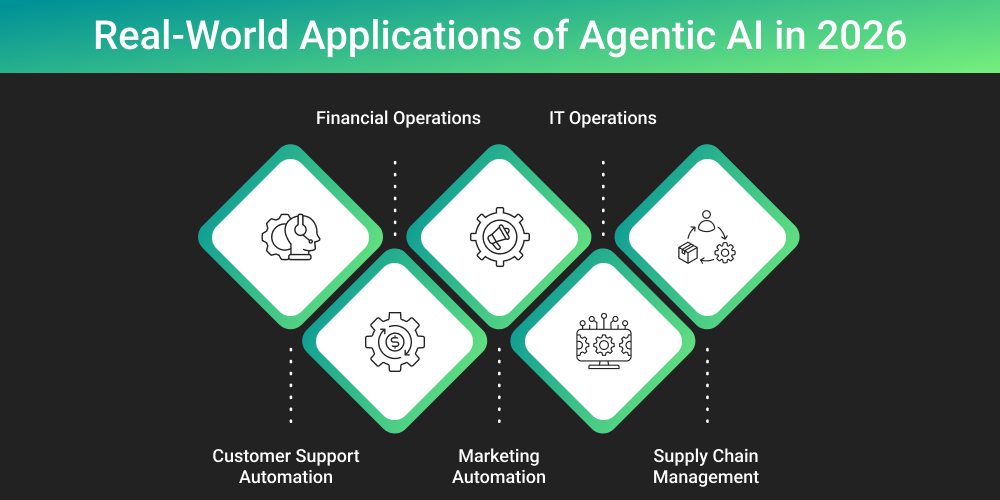
1. Customer Support Automation
Companies use agentic AI for business to handle customer queries, resolve issues, and escalate complex problems automatically.
Modern enterprise AI automation systems can interact across chat, email, and voice platforms.
2. Financial Operations
Banks and fintech companies use agentic AI for fraud detection, risk analysis, and automated reporting. This enhances enterprise AI automation in financial decision-making.
3. Marketing Automation
Marketing teams use agentic AI for business to create campaigns, analyze performance, and optimize targeting strategies in real time.
4. IT Operations
IT departments rely on enterprise AI automation to monitor systems, detect failures, and resolve technical issues without human intervention.
5. Supply Chain Management
Logistics companies use agentic AI to optimize delivery routes, manage inventory, and forecast demand. This improves efficiency in enterprise AI automation systems.
Agentic AI vs Traditional Automation
Traditional automation follows fixed rules and workflows. In contrast, agentic AI for business is dynamic and goal-driven.
| Feature | Traditional Automation | Agentic AI |
| Decision-making | Rule-based | Autonomous |
| Flexibility | Low | High |
| Learning ability | None | Continuous |
| Workflow handling | Task-level | End-to-end |
This comparison highlights why enterprise AI automation is rapidly shifting toward agent-based systems.
Challenges of Implementing Agentic AI
1. Integration Complexity
Integrating agentic AI for business with existing systems can be challenging, especially in legacy infrastructures.
2. Data Security Concerns
Since enterprise AI automation involves sensitive data, security and compliance are major concerns for enterprises.
3. Skill Gaps
Many organizations lack expertise to design and manage agent-based systems, slowing adoption of agentic AI for business.
4. Cost of Implementation
While long-term savings are high, initial investment in enterprise AI automation tools and infrastructure can be significant.
Future Trends in Agentic AI and Enterprise Automation
1. Fully Autonomous Enterprises
By 2026 and beyond, businesses will increasingly rely on agentic AI for business to run entire departments autonomously.
2. Multi-Agent Systems
Future enterprise AI automation will involve multiple AI agents collaborating across departments to complete complex tasks.
3. Human-AI Collaboration
Instead of replacing humans, agentic AI for business will enhance human decision-making and productivity.
4. AI-Driven Business Strategy
Companies will use enterprise AI automation not just for operations but also for strategic planning and forecasting.
Best Practices for Adopting Agentic AI
- Start with small automation workflows
- Choose scalable enterprise AI automation platforms
- Ensure strong data governance and compliance
- Train teams for agentic AI for business adoption
- Continuously monitor and optimize AI performance
Final Thoughts
Agentic AI is not just an upgrade to existing automation systems—it is a complete transformation of how businesses operate. In 2026, companies that adopt agentic AI for business are gaining a major competitive advantage through speed, efficiency, and intelligence.
As enterprise AI automation continues to evolve, organizations will move toward fully autonomous workflows that require minimal human intervention while maximizing productivity and innovation.
Businesses that invest early in agentic AI will be the ones leading the next wave of digital transformation.
Transform Your Business with AI Automation
If you are ready to implement advanced agentic AI for business solutions or upgrade your enterprise AI automation strategy, Getwebb can help you build intelligent, scalable, and future-ready systems.
Our team specializes in AI-powered automation, custom software development, and digital transformation services designed to help businesses grow in 2026 and beyond.