
Artificial intelligence is reshaping how modern software platforms are designed, deployed, and maintained. Instead of relying solely on traditional automation scripts, organizations are increasingly adopting AI agents capable of making informed decisions, coordinating tasks, and responding to real-time system events. Among technology companies exploring this direction, Spotify has become a notable example through its engineering culture and investment in intelligent developer platforms.
The Spotify Agent AI approach demonstrates how autonomous AI systems can simplify software delivery, improve infrastructure reliability, and support engineering teams at scale. Rather than replacing developers, these AI agents assist throughout the software lifecycle—from code validation and testing to deployment monitoring and production optimization.
As cloud-native applications continue growing in complexity, Agent AI Deployment has become a strategic requirement for organizations seeking faster release cycles without compromising security or stability. AI-powered deployment agents can monitor environments, detect anomalies, recommend deployment strategies, and automate repetitive operational workflows while engineers focus on solving higher-value business problems.
This technical case study explores how Spotify Agent AI can be applied during deployment workflows, the architectural components behind intelligent deployment systems, implementation strategies, benefits, challenges, and lessons businesses can adopt for their own AI initiatives.
Understanding Spotify Agent AI
Spotify Agent AI refers to the concept of autonomous AI agents working alongside developers and DevOps teams to improve software engineering operations. These intelligent agents analyze data, execute predefined workflows, collaborate with other services, and continuously learn from operational feedback.
Unlike conventional automation tools that execute fixed scripts, AI agents possess contextual understanding. They evaluate deployment health, identify risks, recommend corrective actions, and even coordinate multiple deployment stages without constant human intervention.
Within modern engineering ecosystems, Spotify Agent AI can assist with:
- Deployment planning
- Infrastructure validation
- Automated testing
- Configuration verification
- Release monitoring
- Incident detection
- Rollback recommendations
- Performance optimization
These capabilities enable organizations to accelerate development while maintaining reliability across distributed cloud environments.
Why Agent AI Deployment Matters
Modern applications often consist of hundreds of microservices deployed across Kubernetes clusters, cloud providers, APIs, databases, and third-party integrations.
Managing these environments manually introduces several challenges:
- Human deployment errors
- Configuration drift
- Slow incident response
- Inconsistent release quality
- Resource inefficiencies
- Longer deployment windows
This is where Agent AI Deployment creates measurable value.
Instead of depending entirely on manual approval chains, intelligent deployment agents continuously evaluate deployment readiness using real-time metrics.
For example, before deployment begins, an AI deployment agent can automatically:
- Validate infrastructure health
- Review security policies
- Analyze recent production incidents
- Detect configuration conflicts
- Verify dependencies
- Estimate deployment risks
If risks exceed acceptable thresholds, the deployment can pause automatically while notifying engineers.
This proactive decision-making significantly reduces production failures.
Also Read : Website Speed Optimisation Tips
The Core Architecture Behind Spotify Agent AI
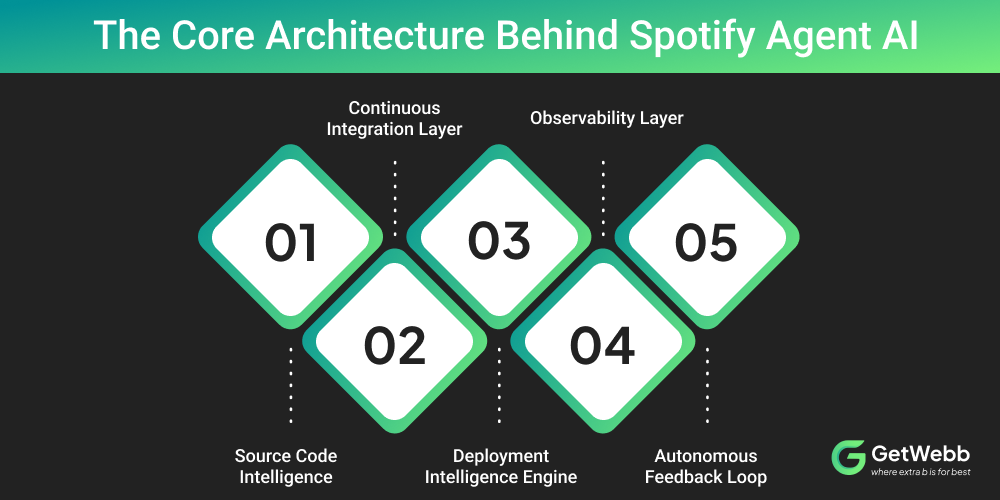
An effective Spotify Agent AI deployment framework consists of several interconnected components working together.
1. Source Code Intelligence
The deployment process begins when developers commit code to the repository.
AI agents immediately analyze:
- Code quality
- Security vulnerabilities
- Dependency risks
- Breaking API changes
- Infrastructure modifications
Instead of waiting until deployment, issues are identified much earlier.
2. Continuous Integration Layer
Once code passes validation, the CI pipeline automatically builds the application.
During this stage, Spotify Agent AI can:
- Prioritize testing
- Skip redundant tasks
- Predict flaky tests
- Allocate computing resources
- Optimize build execution
This reduces build time while maintaining confidence in software quality.
3. Deployment Intelligence Engine
The deployment intelligence engine acts as the brain behind Agent AI Deployment.
Its responsibilities include:
- Deployment scheduling
- Environment validation
- Canary release decisions
- Rollout percentage optimization
- Rollback prediction
- Traffic management
Rather than deploying blindly, every deployment decision is informed by operational data.
4. Observability Layer
Monitoring begins immediately after deployment.
AI agents continuously evaluate:
- CPU utilization
- Memory consumption
- API latency
- Database performance
- User experience metrics
- Error rates
- Service availability
The observability layer allows Spotify Agent AI to identify abnormal behavior within minutes rather than hours.
5. Autonomous Feedback Loop
One defining characteristic of Spotify Agent AI is continuous learning.
After every deployment, AI agents collect operational insights including:
- Deployment duration
- Success rate
- Rollback frequency
- Infrastructure utilization
- Incident reports
- Performance improvements
These insights improve future deployment decisions through reinforcement and historical analysis.
Example Agent AI Deployment Workflow
A simplified deployment workflow powered by Spotify Agent AI may look like this:
Step 1: Code Commit
A developer pushes code to Git.
Immediately, AI agents begin analyzing changes for potential risks.
Step 2: Build Verification
The CI pipeline compiles the application.
The deployment agent validates:
- Build success
- Security scans
- Package integrity
- Infrastructure compatibility
Only compliant builds continue.
Step 3: Automated Testing
Rather than executing every test equally, Spotify Agent AI intelligently prioritizes tests based on affected components.
Critical business services receive additional testing while unrelated services avoid unnecessary execution.
Step 4: Risk Assessment
Before production deployment, the deployment agent calculates a deployment confidence score.
Factors include:
- Historical deployment success
- Recent incidents
- Infrastructure health
- Service dependencies
- Production traffic
If the confidence score falls below policy thresholds, deployment pauses automatically.
Step 5: Canary Deployment
Instead of releasing to every user simultaneously, Agent AI Deployment gradually rolls out changes.
For example:
- 5% traffic
- 15% traffic
- 30% traffic
- 50% traffic
- 100% traffic
At every stage, AI agents monitor system behavior.
If abnormal metrics appear, rollout automatically stops.
Step 6: Intelligent Monitoring
Following deployment, AI continuously evaluates:
- Error spikes
- Performance degradation
- Infrastructure utilization
- API response times
- Customer experience
If thresholds remain healthy, deployment completes successfully.
Step 7: Automated Rollback
If unexpected failures occur, Spotify Agent AI can recommend or automatically execute a rollback to the previous stable version.
This minimizes customer impact while engineering teams investigate the issue.
Also Read : Best AI SEO Tools Businesses
Technologies Supporting Spotify Agent AI
Several technologies commonly power intelligent deployment ecosystems similar to Spotify Agent AI:
| Technology | Purpose |
| Kubernetes | Container orchestration |
| Docker | Application packaging |
| GitHub Actions / GitLab CI | Continuous Integration |
| Argo CD | GitOps deployment |
| Prometheus | Metrics collection |
| Grafana | Visualization |
| OpenTelemetry | Distributed tracing |
| Vector Databases | AI memory |
| Large Language Models | Intelligent reasoning |
| Policy Engines | Deployment governance |
These technologies work together to enable scalable Agent AI Deployment across cloud-native environments.
Key Benefits of Spotify Agent AI
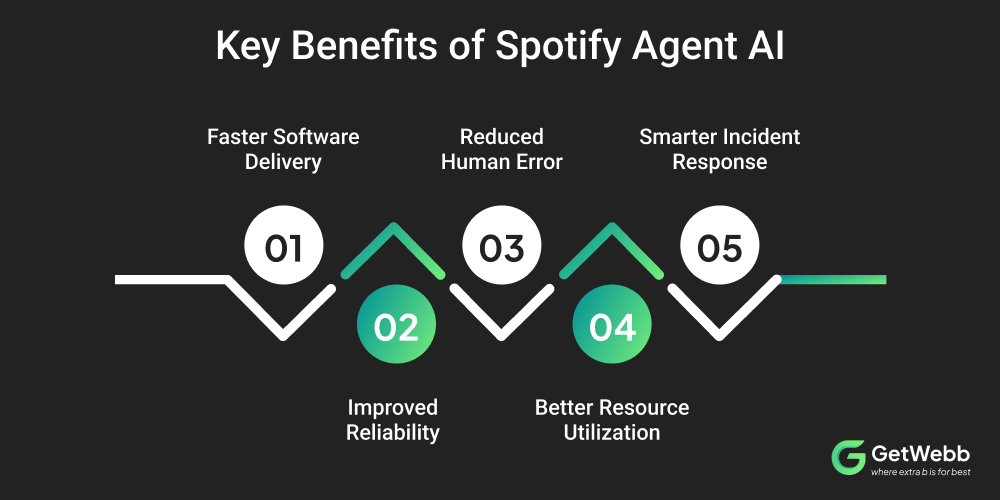
Organizations adopting Spotify Agent AI can gain several operational advantages:
Faster Software Delivery
AI agents automate repetitive deployment activities, allowing engineering teams to release software more frequently.
Improved Reliability
Continuous monitoring enables faster detection of deployment anomalies before they impact customers.
Reduced Human Error
Intelligent validation minimizes configuration mistakes and deployment failures.
Better Resource Utilization
AI optimizes infrastructure allocation during deployment, reducing cloud costs.
Smarter Incident Response
Instead of waiting for manual intervention, AI agents recommend recovery actions based on historical deployment data.
Real-World Agent AI Deployment Scenarios
The principles behind Spotify Agent AI can be adapted across different software environments, especially for organizations managing large-scale cloud infrastructure and continuous delivery pipelines. While every deployment ecosystem is unique, intelligent AI agents can automate repetitive tasks, analyze operational data, and improve deployment reliability.
Here are some common scenarios where Agent AI Deployment delivers measurable value.
1. Multi-Service Microservices Deployment
Modern SaaS platforms often consist of dozens or even hundreds of microservices. Deploying each service manually increases operational complexity and the risk of configuration errors.
Using Spotify Agent AI, deployment agents can:
- Detect service dependencies before deployment
- Validate compatibility between services
- Schedule deployments in the correct sequence
- Prevent cascading failures
- Monitor communication between services after release
This coordinated approach reduces downtime and improves release confidence.
2. Kubernetes Cluster Management
Kubernetes environments constantly change as applications scale, pods restart, and infrastructure evolves.
AI-powered deployment agents can automatically:
- Check cluster health
- Validate node availability
- Monitor pod scheduling
- Recommend scaling actions
- Detect resource bottlenecks
- Predict deployment failures
By incorporating Agent AI Deployment into Kubernetes workflows, engineering teams can improve cluster stability while reducing manual intervention.
3. Progressive Production Releases
Instead of deploying new software to all users simultaneously, AI agents can orchestrate progressive rollouts.
For example:
- Deploy to internal users
- Expand to 5% of production traffic
- Monitor application performance
- Increase traffic gradually
- Roll back automatically if abnormal behavior is detected
This deployment strategy significantly reduces production risk while maintaining a positive user experience.
4. Infrastructure Configuration Validation
Infrastructure changes can introduce unexpected issues, particularly in cloud-native environments.
Before deployment, Spotify Agent AI can compare infrastructure configurations against approved policies to identify:
- Missing environment variables
- Incorrect permissions
- Invalid secrets
- Misconfigured networking
- Storage inconsistencies
- Policy violations
Early validation helps prevent deployment failures before they reach production.
Challenges in Agent AI Deployment
Although the benefits are significant, implementing Agent AI Deployment requires careful planning. Organizations should understand the technical and operational challenges involved.
Data Quality
AI agents rely on historical deployment data, logs, metrics, and monitoring information. Incomplete or inaccurate data can lead to poor recommendations and unreliable automation.
Maintaining high-quality observability data is essential for successful Spotify Agent AI implementations.
Integration Complexity
Most enterprises already use a combination of CI/CD tools, cloud platforms, monitoring solutions, and security systems.
Integrating AI agents into these existing workflows may require:
- API integrations
- Event-driven architectures
- Standardized deployment pipelines
- Shared observability frameworks
- Cross-platform authentication
A phased implementation often reduces integration risks.
Explainability
Engineering teams need to understand why an AI agent recommends or executes a particular deployment decision.
Transparent decision-making improves trust by providing explanations such as:
- Risk score calculations
- Deployment confidence levels
- Performance trends
- Historical deployment comparisons
- Policy evaluations
Explainable AI is a key principle for enterprise adoption.
Security Considerations
Because deployment agents can influence production systems, security must remain a top priority.
Organizations should implement:
- Role-based access control (RBAC)
- Multi-factor authentication
- Secret management
- Encryption for sensitive data
- Audit logging
- Least-privilege permissions
Strong governance ensures Agent AI Deployment supports operational goals without introducing unnecessary risk.
Best Practices for Successful Agent AI Deployment
Organizations planning to implement Spotify Agent AI can improve outcomes by following these best practices.
Start with Low-Risk Automation
Begin by automating repetitive deployment tasks such as:
- Build validation
- Test execution
- Deployment monitoring
- Log analysis
As confidence grows, gradually expand AI responsibilities to more critical deployment activities.
Build Strong Observability
AI agents perform best when they have access to comprehensive operational data.
Monitor:
- Infrastructure metrics
- Application logs
- Distributed traces
- Deployment events
- User experience indicators
Comprehensive observability enables more accurate deployment decisions.
Keep Humans in the Loop
Although Spotify Agent AI can automate many operational processes, human oversight remains important.
Critical production releases should include approval workflows where engineers review AI recommendations before deployment.
This balance combines automation with expert judgment.
Continuously Evaluate AI Performance
Deployment agents should be monitored just like production applications.
Key performance indicators include:
- Deployment success rate
- Rollback frequency
- False-positive alerts
- Mean time to recovery (MTTR)
- Deployment duration
- Infrastructure utilization
Regular evaluation helps refine AI models and improve deployment quality over time.
Prioritize Security and Compliance
Security policies should be integrated directly into the deployment workflow.
Examples include:
- Automated compliance validation
- Vulnerability scanning
- Infrastructure policy enforcement
- Secret detection
- License compliance checks
Embedding these controls into Agent AI Deployment helps reduce operational risk while supporting regulatory requirements.
Also Read : Search Engine Optimisation Australia
The Future of Spotify Agent AI
As AI technologies continue to evolve, deployment agents are expected to become more autonomous, collaborative, and context-aware.
Future capabilities may include:
- Self-optimizing deployment pipelines
- Predictive infrastructure scaling
- Automated incident remediation
- Cross-cloud deployment coordination
- AI-powered cost optimization
- Natural language deployment assistants
- Multi-agent collaboration across engineering teams
Rather than replacing developers or DevOps engineers, these intelligent systems will increasingly serve as collaborative assistants that enhance productivity and decision-making.
Organizations investing in Spotify Agent AI today will be better positioned to adapt to the next generation of software delivery and cloud operations.
Conclusion
The growing complexity of cloud-native applications demands smarter approaches to software delivery. Traditional automation remains valuable, but modern engineering teams increasingly benefit from intelligent systems that can analyze data, identify risks, and support informed deployment decisions.
The Spotify Agent AI approach illustrates how AI agents can enhance deployment workflows by validating infrastructure, optimizing release strategies, monitoring production health, and recommending corrective actions. When implemented with strong observability, security, and governance practices, Agent AI Deployment can improve release reliability, accelerate development cycles, and reduce operational overhead.
As AI-driven software engineering continues to mature, organizations that combine automation with human expertise will be well-positioned to deliver resilient, scalable, and efficient digital products.
Build Intelligent AI-Powered Software with GetWebb
Looking to integrate AI into your software development or deployment workflows? GetWebb helps businesses build secure, scalable, and cloud-ready digital solutions tailored to modern engineering needs. Whether you’re developing AI-powered applications, implementing DevOps best practices, or modernizing your software infrastructure, our experienced team can help you turn innovative ideas into reliable products.
Contact GetWebb today to discuss your next AI, web, or software development project and build solutions designed for long-term growth.